---
title: Debug logging
description: AM services capture a variety of information in debug logs. Unlike audit log records, debug log records are unstructured. Debug logs contain different types of information that is useful when troubleshooting AM, including stack traces.
component: pingam
version: 7.2
page_id: pingam:maintenance-guide:debug-logging
canonical_url: https://docs.pingidentity.com/pingam/8/maintenance/debug-logging.html
llms_txt: https://docs.pingidentity.com/pingam/llms.txt
docs_for_agents: https://developer.pingidentity.com/build-with-ai/docs-for-agents.md
keywords: ["Troubleshooting"]
superseded_by: https://docs.pingidentity.com/pingam/8/maintenance/debug-logging.html
section_ids:
to-enable-debug-logging-logback: Temporarily enable debug logging with Logback.jsp
persistent-logging-logback-xml: Persistent debug logging with logback.xml
config-basic-logging: Configure basic debug logging
output-stdout: Output to stdout
output-multiple-locations: Output to multiple locations
format-log-files: Format log files
log-rotate-debug: Rotate debug logs
log-debug-defaults: Change the startup debug settings
log-debug-levels: Set the default debug level
log-debug-directory: Set the default debug directory
log-debug-single-file: Combine log messages in a single file
---
# Debug logging
AM services capture a variety of information in debug logs. Unlike audit log records, debug log records are unstructured. Debug logs contain different types of information that is useful when troubleshooting AM, including stack traces.
AM uses [Logback](https://logback.qos.ch/) as the handler for debug logging, making it easily customizable. For example, the level of debug log record output is configurable, as is the storage location and format.
AM lets you enable the debug log level for specific classes in the AM code base. This can be useful when you must turn on debug logging in a production system where you want to avoid excessive logging, but must gather messages when you reproduce a problem.
You can choose the level of logging from the following options:
* `Off`
No debug messages are logged.
* `Error`
Debug messages signifying that an error has occurred are logged.
* `Warning`
Debug messages signifying potentially harmful situations are logged.
* `Information`
Debug messages that contain coarse-grained information about the status of AM are logged.
* `Debug`
Debug messages that contain fine-grained information useful for troubleshooting AM are logged.
This is the default level.
* `Trace`
All debug messages are logged.
Create *loggers* to specify the debug level for a class, and choose where the output is recorded. The logger used by a feature in AM is hierarchical, based on the class that is creating the debug messages. The most specific logger is used, which is the logger whose path most closely matches the class that is creating the log messages.
For example, if you knew there was an issue in an authentication module, you might enable trace-level debug logging in `org.forgerock.openam.authentication.modules`. If you are not sure where the problem lies, you may choose a broader option, for example `org.forgerock.openam.authentication`.
The least-specific, catch-all logger is named `ROOT`.
AM also logs information related to client interactions using the `org.apache.http.wire` and `org.apache.http.headers` appenders. The information they collect is useful, for example, when you are developing authentication scripts or when your environment requires STS transformations.
By default, these appenders are always set to the `Warning` level unless logging is disabled. For more information, see the [org.forgerock.allow.http.client.debug](../reference/deployment-configuration-reference.html#appenders-debug) advanced server property.
You can configure debug logging temporarily by using the AM admin UI, or you can create a file in the AM classpath with persistent debug configuration.
## Temporarily enable debug logging with `Logback.jsp`
These steps let you temporarily capture debug messages, until the next time AM or the container in which it runs is restarted.
1. In the AM admin UI, go to `Logback.jsp` in the root context of the AM installation, for example `https://openam.example.com:8443/openam/Logback.jsp`.
No links to this page are provided in the AM admin UI.
| | |
| - | ----------------------------------------------------------------------------------------------------------------------------------------------------- |
| | Only the `amAdmin` administrator account can access the `Logback.jsp` page and alter the debug settings; delegated administrators do not have access. |
The page displays all the appenders and their associated debug loggers:
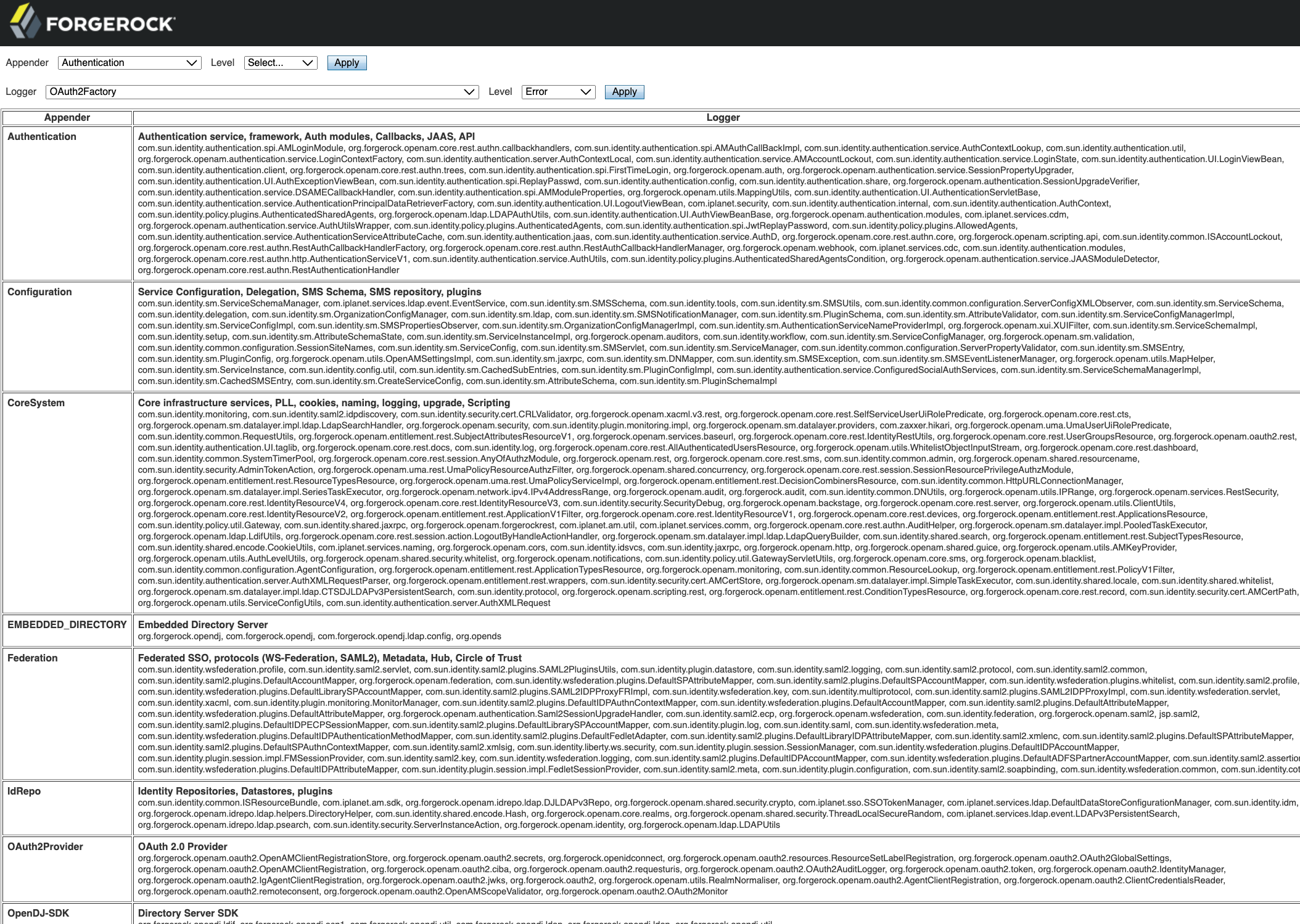
> **Collapse: Logback.jsp logger names**
>
> The following lists contain the available logger names ordered by their associated appender:
>
> > **Collapse: Authentication**
> >
> > ```
> > Authentication service, framework, Auth modules, Callbacks, JAAS, API
> > com.sun.identity.authentication.spi.AMLoginModule,
> > org.forgerock.openam.core.rest.authn.callbackhandlers,
> > com.sun.identity.authentication.spi.AMAuthCallBackImpl,
> > com.sun.identity.authentication.service.AuthContextLookup,
> > com.sun.identity.authentication.util,
> > org.forgerock.openam.authentication.service.LoginContextFactory,
> > com.sun.identity.authentication.server.AuthContextLocal,
> > com.sun.identity.authentication.service.AMAccountLockout,
> > com.sun.identity.authentication.service.LoginState,
> > com.sun.identity.authentication.UI.LoginViewBean,
> > com.sun.identity.authentication.client,
> > org.forgerock.openam.core.rest.authn.trees,
> > com.sun.identity.authentication.spi.FirstTimeLogin,
> > org.forgerock.openam.auth,
> > org.forgerock.openam.authentication.service.SessionPropertyUpgrader,
> > com.sun.identity.authentication.UI.AuthExceptionViewBean,
> > com.sun.identity.authentication.spi.ReplayPasswd,
> > com.sun.identity.authentication.config,
> > com.sun.identity.authentication.share,
> > org.forgerock.openam.authentication.SessionUpgradeVerifier,
> > com.sun.identity.authentication.service.DSAMECallbackHandler,
> > com.sun.identity.authentication.spi.AMModuleProperties,
> > org.forgerock.openam.utils.MappingUtils,
> > com.sun.identity.authentication.UI.AuthenticationServletBase,
> > com.sun.identity.authentication.service.AuthenticationPrincipalDataRetrieverFactory,
> > com.sun.identity.authentication.UI.LogoutViewBean,
> > com.iplanet.security,
> > com.sun.identity.authentication.internal,
> > com.sun.identity.authentication.AuthContext,
> > com.sun.identity.policy.plugins.AuthenticatedSharedAgents,
> > org.forgerock.openam.ldap.LDAPAuthUtils,
> > com.sun.identity.authentication.UI.AuthViewBeanBase,
> > org.forgerock.openam.authentication.modules,
> > com.iplanet.services.cdm,
> > org.forgerock.openam.authentication.service.AuthUtilsWrapper,
> > com.sun.identity.policy.plugins.AuthenticatedAgents,
> > com.sun.identity.authentication.spi.JwtReplayPassword,
> > com.sun.identity.policy.plugins.AllowedAgents,
> > com.sun.identity.authentication.service.AuthenticationServiceAttributeCache,
> > com.sun.identity.authentication.jaas,
> > com.sun.identity.authentication.service.AuthD,
> > org.forgerock.openam.core.rest.authn.core,
> > org.forgerock.openam.scripting.api,
> > com.sun.identity.common.ISAccountLockout,
> > org.forgerock.openam.core.rest.authn.RestAuthCallbackHandlerFactory,
> > org.forgerock.openam.core.rest.authn.RestAuthCallbackHandlerManager,
> > org.forgerock.openam.webhook,
> > com.iplanet.services.cdc,
> > com.sun.identity.authentication.modules,
> > org.forgerock.openam.core.rest.authn.http.AuthenticationServiceV1,
> > com.sun.identity.authentication.service.AuthUtils,
> > com.sun.identity.policy.plugins.AuthenticatedSharedAgentsCondition,
> > org.forgerock.openam.authentication.service.JAASModuleDetector,
> > org.forgerock.openam.core.rest.authn.RestAuthenticationHandler
> > ```
>
> > **Collapse: Configuration**
> >
> > ```
> > Service Configuration, Delegation, SMS Schema, SMS repository, plugins
> > com.sun.identity.sm.ServiceSchemaManager,
> > com.iplanet.services.ldap.event.EventService,
> > com.sun.identity.sm.SMSSchema,
> > com.sun.identity.tools,
> > com.sun.identity.sm.SMSUtils,
> > com.sun.identity.common.configuration.ServerConfigXMLObserver,
> > com.sun.identity.sm.ServiceSchema,
> > com.sun.identity.delegation,
> > com.sun.identity.sm.OrganizationConfigManager,
> > com.sun.identity.sm.ldap,
> > com.sun.identity.sm.SMSNotificationManager,
> > com.sun.identity.sm.PluginSchema,
> > com.sun.identity.sm.AttributeValidator,
> > com.sun.identity.sm.ServiceConfigManagerImpl,
> > com.sun.identity.sm.ServiceConfigImpl,
> > com.sun.identity.sm.SMSPropertiesObserver,
> > com.sun.identity.sm.OrganizationConfigManagerImpl,
> > com.sun.identity.sm.AuthenticationServiceNameProviderImpl,
> > org.forgerock.openam.xui.XUIFilter,
> > com.sun.identity.sm.ServiceSchemaImpl,
> > com.sun.identity.setup,
> > com.sun.identity.sm.AttributeSchemaState,
> > com.sun.identity.sm.ServiceInstanceImpl,
> > org.forgerock.openam.auditors,
> > com.sun.identity.workflow,
> > com.sun.identity.sm.ServiceConfigManager,
> > org.forgerock.openam.sm.validation,
> > com.sun.identity.common.configuration.SessionSiteNames,
> > com.sun.identity.sm.ServiceConfig,
> > com.sun.identity.sm.SMServlet,
> > com.sun.identity.sm.ServiceManager,
> > com.sun.identity.common.configuration.ServerPropertyValidator,
> > com.sun.identity.sm.SMSEntry,
> > com.sun.identity.sm.PluginConfig,
> > org.forgerock.openam.utils.OpenAMSettingsImpl,
> > com.sun.identity.sm.jaxrpc,
> > com.sun.identity.sm.DNMapper,
> > com.sun.identity.sm.SMSException,
> > com.sun.identity.sm.SMSEventListenerManager,
> > org.forgerock.openam.utils.MapHelper,
> > com.sun.identity.sm.ServiceInstance,
> > com.sun.identity.config.util,
> > com.sun.identity.sm.CachedSubEntries,
> > com.sun.identity.sm.PluginConfigImpl,
> > com.sun.identity.authentication.service.ConfiguredSocialAuthServices,
> > com.sun.identity.sm.ServiceSchemaManagerImpl,
> > com.sun.identity.sm.CachedSMSEntry,
> > com.sun.identity.sm.CreateServiceConfig,
> > com.sun.identity.sm.AttributeSchema,
> > com.sun.identity.sm.PluginSchemaImpl
> > ```
>
> > **Collapse: CoreSystem**
> >
> > ```
> > Core infrastructure services, PLL, cookies, naming, logging, upgrade, Scripting
> > com.sun.identity.monitoring,
> > com.sun.identity.saml2.idpdiscovery,
> > com.sun.identity.security.cert.CRLValidator,
> > org.forgerock.openam.xacml.v3.rest,
> > org.forgerock.openam.core.rest.SelfServiceUserUiRolePredicate,
> > org.forgerock.openam.core.rest.cts,
> > org.forgerock.openam.sm.datalayer.impl.ldap.LdapSearchHandler,
> > org.forgerock.openam.security,
> > com.sun.identity.plugin.monitoring.impl,
> > org.forgerock.openam.sm.datalayer.providers,
> > com.zaxxer.hikari,
> > org.forgerock.openam.uma.UmaUserUiRolePredicate,
> > com.sun.identity.common.RequestUtils,
> > org.forgerock.openam.entitlement.rest.SubjectAttributesResourceV1,
> > org.forgerock.openam.services.baseurl,
> > org.forgerock.openam.core.rest.IdentityRestUtils,
> > org.forgerock.openam.core.rest.UserGroupsResource,
> > org.forgerock.openam.oauth2.rest,
> > com.sun.identity.authentication.UI.taglib,
> > org.forgerock.openam.core.rest.docs,
> > com.sun.identity.log,
> > org.forgerock.openam.core.rest.AllAuthenticatedUsersResource,
> > org.forgerock.openam.utils.WhitelistObjectInputStream,
> > org.forgerock.openam.core.rest.dashboard,
> > com.sun.identity.common.SystemTimerPool,
> > org.forgerock.openam.core.rest.session.AnyOfAuthzModule,
> > org.forgerock.openam.rest,
> > org.forgerock.openam.core.rest.sms,
> > com.sun.identity.common.admin,
> > org.forgerock.openam.shared.resourcename,
> > com.sun.identity.security.AdminTokenAction,
> > org.forgerock.openam.uma.rest.UmaPolicyResourceAuthzFilter,
> > org.forgerock.openam.shared.concurrency,
> > org.forgerock.openam.core.rest.session.SessionResourcePrivilegeAuthzModule,
> > org.forgerock.openam.entitlement.rest.ResourceTypesResource,
> > org.forgerock.openam.uma.rest.UmaPolicyServiceImpl,
> > org.forgerock.openam.entitlement.rest.DecisionCombinersResource,
> > com.sun.identity.common.HttpURLConnectionManager,
> > org.forgerock.openam.sm.datalayer.impl.SeriesTaskExecutor,
> > org.forgerock.openam.network.ipv4.IPv4AddressRange,
> > org.forgerock.openam.audit,
> > org.forgerock.audit,
> > com.sun.identity.common.DNUtils,
> > org.forgerock.openam.utils.IPRange,
> > org.forgerock.openam.services.RestSecurity,
> > org.forgerock.openam.core.rest.IdentityResourceV4,
> > org.forgerock.openam.core.rest.IdentityResourceV3,
> > com.sun.identity.security.SecurityDebug,
> > org.forgerock.openam.backstage,
> > org.forgerock.openam.core.rest.server,
> > org.forgerock.openam.utils.ClientUtils,
> > org.forgerock.openam.core.rest.IdentityResourceV2,
> > org.forgerock.openam.entitlement.rest.ApplicationV1Filter,
> > org.forgerock.openam.core.rest.IdentityResourceV1,
> > org.forgerock.openam.core.rest.devices,
> > org.forgerock.openam.entitlement.rest.ApplicationsResource,
> > com.sun.identity.policy.util.Gateway,
> > com.sun.identity.shared.jaxrpc,
> > org.forgerock.openam.forgerockrest,
> > com.iplanet.am.util,
> > com.iplanet.services.comm,
> > org.forgerock.openam.core.rest.authn.AuditHelper,
> > org.forgerock.openam.sm.datalayer.impl.PooledTaskExecutor,
> > org.forgerock.openam.ldap.LdifUtils,
> > org.forgerock.openam.core.rest.session.action.LogoutByHandleActionHandler,
> > org.forgerock.openam.sm.datalayer.impl.ldap.LdapQueryBuilder,
> > com.sun.identity.shared.search,
> > org.forgerock.openam.entitlement.rest.SubjectTypesResource,
> > com.sun.identity.shared.encode.CookieUtils,
> > com.iplanet.services.naming,
> > org.forgerock.openam.cors,
> > com.sun.identity.idsvcs,
> > com.sun.identity.jaxrpc,
> > org.forgerock.openam.http,
> > org.forgerock.openam.shared.guice,
> > org.forgerock.openam.utils.AMKeyProvider,
> > org.forgerock.openam.utils.AuthLevelUtils,
> > org.forgerock.openam.shared.security.whitelist,
> > org.forgerock.openam.notifications,
> > com.sun.identity.policy.util.GatewayServletUtils,
> > org.forgerock.openam.core.sms,
> > org.forgerock.openam.blacklist,
> > com.sun.identity.common.configuration.AgentConfiguration,
> > org.forgerock.openam.entitlement.rest.ApplicationTypesResource,
> > org.forgerock.openam.monitoring,
> > com.sun.identity.common.ResourceLookup,
> > org.forgerock.openam.entitlement.rest.PolicyV1Filter,
> > com.sun.identity.authentication.server.AuthXMLRequestParser,
> > org.forgerock.openam.entitlement.rest.wrappers,
> > com.sun.identity.security.cert.AMCertStore,
> > org.forgerock.openam.sm.datalayer.impl.SimpleTaskExecutor,
> > com.sun.identity.shared.locale,
> > com.sun.identity.shared.whitelist,
> > org.forgerock.openam.sm.datalayer.impl.ldap.CTSDJLDAPv3PersistentSearch,
> > com.sun.identity.protocol,
> > org.forgerock.openam.scripting.rest,
> > org.forgerock.openam.entitlement.rest.ConditionTypesResource,
> > org.forgerock.openam.core.rest.record,
> > com.sun.identity.security.cert.AMCertPath,
> > org.forgerock.openam.utils.ServiceConfigUtils,
> > com.sun.identity.authentication.server.AuthXMLRequest
> > ```
>
> > **Collapse: EMBEDDED_DIRECTORY**
> >
> > ```
> > Embedded Directory Server
> > org.forgerock.opendj,
> > com.forgerock.opendj,
> > com.forgerock.opendj.ldap.config,
> > org.opends
> > ```
>
> > **Collapse: Federation**
> >
> > ```
> > Federated SSO, protocols (WS-Federation, SAML2), Metadata, Hub, Circle of Trust
> > com.sun.identity.wsfederation.profile,
> > com.sun.identity.saml2.servlet,
> > com.sun.identity.saml2.plugins.SAML2PluginsUtils,
> > com.sun.identity.plugin.datastore,
> > com.sun.identity.saml2.logging,
> > com.sun.identity.saml2.protocol,
> > com.sun.identity.saml2.common,
> > com.sun.identity.saml2.plugins.DefaultAccountMapper,
> > org.forgerock.openam.federation,
> > com.sun.identity.wsfederation.plugins.DefaultSPAttributeMapper,
> > com.sun.identity.saml2.plugins.DefaultSPAccountMapper,
> > com.sun.identity.wsfederation.plugins.whitelist,
> > com.sun.identity.saml2.profile,
> > com.sun.identity.wsfederation.plugins.DefaultLibrarySPAccountMapper,
> > com.sun.identity.saml2.plugins.SAML2IDPProxyFRImpl,
> > com.sun.identity.wsfederation.key,
> > com.sun.identity.multiprotocol,
> > com.sun.identity.saml2.plugins.SAML2IDPProxyImpl,
> > com.sun.identity.wsfederation.servlet,
> > com.sun.identity.xacml,
> > com.sun.identity.plugin.monitoring.MonitorManager,
> > com.sun.identity.saml2.plugins.DefaultIDPAuthnContextMapper,
> > com.sun.identity.wsfederation.plugins.DefaultAccountMapper,
> > com.sun.identity.saml2.plugins.DefaultAttributeMapper,
> > com.sun.identity.wsfederation.plugins.DefaultAttributeMapper,
> > org.forgerock.openam.authentication.Saml2SessionUpgradeHandler,
> > com.sun.identity.saml2.ecp,
> > org.forgerock.openam.wsfederation,
> > com.sun.identity.federation,
> > org.forgerock.openam.saml2,
> > jsp.saml2,
> > com.sun.identity.saml2.plugins.DefaultIDPECPSessionMapper,
> > com.sun.identity.saml2.plugins.DefaultLibrarySPAccountMapper,
> > com.sun.identity.plugin.log,
> > com.sun.identity.saml,
> > com.sun.identity.wsfederation.meta,
> > com.sun.identity.wsfederation.plugins.DefaultIDPAuthenticationMethodMapper,
> > com.sun.identity.saml2.plugins.DefaultFedletAdapter,
> > com.sun.identity.saml2.plugins.DefaultLibraryIDPAttributeMapper,
> > com.sun.identity.saml2.xmlenc,
> > com.sun.identity.saml2.plugins.DefaultSPAttributeMapper,
> > com.sun.identity.saml2.plugins.DefaultSPAuthnContextMapper,
> > com.sun.identity.saml2.xmlsig,
> > com.sun.identity.liberty.ws.security,
> > com.sun.identity.plugin.session.SessionManager,
> > com.sun.identity.wsfederation.plugins.DefaultIDPAccountMapper,
> > com.sun.identity.plugin.session.impl.FMSessionProvider,
> > com.sun.identity.saml2.key,
> > com.sun.identity.wsfederation.logging,
> > com.sun.identity.saml2.plugins.DefaultIDPAccountMapper,
> > com.sun.identity.wsfederation.plugins.DefaultADFSPartnerAccountMapper,
> > com.sun.identity.saml2.assertion,
> > com.sun.identity.wsfederation.plugins.DefaultIDPAttributeMapper,
> > com.sun.identity.plugin.session.impl.FedletSessionProvider,
> > com.sun.identity.saml2.meta,
> > com.sun.identity.plugin.configuration,
> > com.sun.identity.saml2.soapbinding,
> > com.sun.identity.wsfederation.common,
> > com.sun.identity.cot
> > ```
>
> > **Collapse: IdRepo**
> >
> > ```
> > Identity Repositories, Datastores, plugins
> > com.sun.identity.common.ISResourceBundle,
> > com.iplanet.am.sdk,
> > org.forgerock.openam.idrepo.ldap.DJLDAPv3Repo,
> > org.forgerock.openam.shared.security.crypto,
> > com.iplanet.sso.SSOTokenManager,
> > com.iplanet.services.ldap.DefaultDataStoreConfigurationManager,
> > com.sun.identity.idm,
> > org.forgerock.openam.idrepo.ldap.helpers.DirectoryHelper,
> > com.sun.identity.shared.encode.Hash,
> > org.forgerock.openam.core.realms,
> > org.forgerock.openam.shared.security.ThreadLocalSecureRandom,
> > com.iplanet.services.ldap.event.LDAPv3PersistentSearch,
> > org.forgerock.openam.idrepo.ldap.psearch,
> > com.sun.identity.security.ServerInstanceAction,
> > org.forgerock.openam.identity,
> > org.forgerock.openam.ldap.LDAPUtils
> > ```
>
> > **Collapse: OAuth2Provider**
> >
> > ```
> > OAuth 2.0 Provider
> > org.forgerock.openam.oauth2.OpenAMClientRegistrationStore,
> > org.forgerock.openam.oauth2.secrets,
> > org.forgerock.openidconnect,
> > org.forgerock.openam.oauth2.resources.ResourceSetLabelRegistration,
> > org.forgerock.openam.oauth2.OAuth2GlobalSettings,
> > org.forgerock.openam.oauth2.OpenAMClientRegistration,
> > org.forgerock.openam.oauth2.ciba,
> > org.forgerock.openam.oauth2.requesturis,
> > org.forgerock.openam.oauth2.OAuth2AuditLogger,
> > org.forgerock.openam.oauth2.token,
> > org.forgerock.openam.oauth2.IdentityManager,
> > org.forgerock.openam.oauth2.IgAgentClientRegistration,
> > org.forgerock.openam.oauth2.jwks,
> > org.forgerock.oauth2,
> > org.forgerock.openam.utils.RealmNormaliser,
> > org.forgerock.openam.oauth2.AgentClientRegistration,
> > org.forgerock.openam.oauth2.ClientCredentialsReader,
> > org.forgerock.openam.oauth2.remoteconsent,
> > org.forgerock.openam.oauth2.OpenAMScopeValidator,
> > org.forgerock.openam.oauth2.OAuth2Monitor
> > ```
>
> > **Collapse: OpenDJ-SDK**
> >
> > ```
> > Directory Server SDK
> > org.forgerock.opendj.ldif,
> > org.forgerock.opendj.asn1,
> > com.forgerock.opendj.util,
> > com.forgerock.opendj.ldap,
> > org.forgerock.opendj.ldap,
> > org.forgerock.opendj.util
> > ```
>
> > **Collapse: OtherLogging**
> >
> > ```
> > Miscellaneous logs
> > org.forgerock.openam.secrets.SecretIdChoiceValues,
> > org.forgerock.am.iot.IntrospectTokenActionHandler,
> > com.sun.identity.sm.SmsObjectResolver,
> > org.forgerock.config.resolvers,
> > org.forgerock.openam.services.datastore,
> > org.forgerock.openam.utils.JCECipherProvider,
> > org.forgerock.config.resolvers.SystemPropertyResolver,
> > com.sun.identity.policy.plugins,
> > org.forgerock.openam.entitlement.rest,
> > org.forgerock.openam.services.datastore.DataStoreConsistencyFilter,
> > org.forgerock.openam.oauth2.saml2,
> > org.forgerock.secrets.propertyresolver.PropertyResolverSecretStore,
> > org.forgerock.openam.headers.DisableSameSiteCookiesFilter,
> > org.forgerock.openam.oauth2.resources,
> > org.forgerock.openam.uma.rest,
> > org.forgerock.openam.integration.idm.IdmClientIdRepo,
> > org.forgerock.am.health.HealthCheckService,
> > com.sun.identity.shared,
> > org.forgerock.openam.network.ipv4,
> > com.forgerock,
> > org.forgerock.openam.core.rest.session,
> > org.forgerock.util.encode.Base64url,
> > org.forgerock.openam.core.rest,
> > com.iplanet.services.ldap.ServerGroup,
> > org.forgerock.am.iot.ThingsResource,
> > org.forgerock.openam.uma,
> > org.forgerock.openam.secrets.config.GoogleKeyManagementServiceSecretStore,
> > org.forgerock.api.models.Resource,
> > org.forgerock.openam.oauth2.saml2.core.Saml2GrantTypeHandler,
> > com.sun.identity.configuration.ConfigFedMonitoring,
> > org.forgerock.openam.setup.BootstrapSubstitutionService,
> > org.forgerock.util.promise,
> > org.forgerock.config.resolvers.EnvironmentVariableResolver,
> > org.forgerock.config.util,
> > org.forgerock.openam.scripting.ScriptEngineConfigurator,
> > org.forgerock.openam.oauth2.guice,
> > org.forgerock.openam.scripting.persistence,
> > org.forgerock.api.models.Items,
> > org.forgerock.openam.homedirectory.HomeDirectoryUtils,
> > org.forgerock.openam.selfservice,
> > com.iplanet.services,
> > org.forgerock.openam.scripting.ThreadPoolScriptEvaluator,
> > jsp,
> > org.forgerock.am.health.ReadinessCheckEndpoint,
> > io.swagger.models.parameters.AbstractSerializableParameter,
> > org.forgerock.openam.social,
> > com.sun.identity.plugin.monitoring,
> > org.forgerock.openam.services.MailService,
> > OAuth2Factory,
> > org.apache.http.headers,
> > org.forgerock.json,
> > org.forgerock.openam.oauth2.OAuth2UrisFactory,
> > com.sun.identity.shared.encode,
> > org.forgerock.http.swagger,
> > com.iplanet,
> > com.sun.identity.common.configuration,
> > org.forgerock.json.resource.InterfaceCollectionInstance,
> > org.forgerock.json.resource.http.HttpUtils,
> > org.forgerock.openam.uma.UmaProviderSettingsFactory,
> > org.forgerock.openam.utils,
> > org.forgerock.openam.scripting,
> > org.forgerock.openam.uma.rest.UmaEnabledFilter,
> > org.forgerock.openam.sts.publish.rest.RestSTSSetupListener,
> > org.forgerock.util.encode.Base64,
> > com.zaxxer,
> > org.forgerock.openam.oauth2.guice.OAuth2GuiceModule,
> > org.forgerock.openam.social.idp.SocialIdpJwksSecretsProvider,
> > org.forgerock.secrets,
> > org.forgerock.util.promise.Promises,
> > org.forgerock.secrets.SecretReference,
> > org.forgerock.openam.sts.publish.common.STSInstanceConfigStoreBase,
> > io.swagger.models.parameters,
> > org.forgerock.openam.sts.publish.common,
> > io.swagger,
> > org.forgerock.openam.oauth2.pop,
> > org.forgerock.openam.sm.datalayer,
> > org.forgerock.openam.social.idp.choiceValues.AllowedJweAlgorithms,
> > org.forgerock.http,
> > oauth2,
> > org.forgerock.openam.service.datastore.LdapDataStoreService,
> > org.forgerock.http.filter,
> > org.apache.http.wire,
> > org.forgerock.http.swagger.OpenApiRequestFilter,
> > org.forgerock.openam.xui,
> > org.forgerock.api.models,
> > com.iplanet.services.ldap.event,
> > org.forgerock.json.jose.jws.SigningManager,
> > com.sun.identity.shared.xml.XMLUtils,
> > org.forgerock.http.oauth2,
> > org.forgerock.util.promise.PromiseImpl,
> > org.forgerock.openam.secrets,
> > org.forgerock.openam.sts.publish.service,
> > org.forgerock.openam.sm.config.ConsoleConfigHandlerImpl,
> > org.forgerock.openam.integration.idm,
> > com.sun.identity.authentication,
> > io.swagger.models,
> > org.forgerock.openam.selfservice.SelfServiceRequestHandler,
> > org.forgerock.am.health.LivenessCheckEndpoint,
> > com.sun.identity.sm.RootSuffixProvider,
> > org.forgerock.am.iot,
> > idRepoAuditor,
> > org.forgerock.openam.sm.datalayer.impl,
> > org.forgerock.http.util,
> > com.sun.identity.plugin.session.impl,
> > com.sun.identity.common,
> > org.forgerock.openam.utils.PerThreadCache,
> > com.sun.identity.shared.xml,
> > org.forgerock.openam.service.datastore,
> > com.sun.identity.shared.datastruct,
> > org.forgerock.json.jose.jws,
> > com.sun.identity.common.configuration.ConfigurationObserver,
> > com.sun.identity.configuration,
> > org.forgerock.http.filter.TransactionIdInboundFilter,
> > frRest,
> > org.forgerock.secrets.propertyresolver,
> > org.apache,
> > org.forgerock.openam.service,
> > org.forgerock.openam.secrets.SecretsUtils,
> > org.forgerock.openam.utils.LogUtils,
> > ROOT,
> > com.sun.identity.common.ShutdownManager,
> > org.forgerock.am.iot.GetAccessTokenActionHandler,
> > org.forgerock.openam.core.rest.authn,
> > org.forgerock.openam.scripting.persistence.config.consumer.ScriptTypeAdapter,
> > com.sun,
> > org.forgerock.util.i18n,
> > org.forgerock.openam.entitlement.service.ApplicationServiceImpl,
> > com.sun.identity.policy.plugins.PrefixResourceName,
> > com.sun.identity.wsfederation.plugins,
> > org.forgerock.openam.secrets.config.GoogleSecretManagerSecretStoreProvider,
> > org.forgerock.api.transform,
> > org,
> > org.forgerock.util.encode,
> > com.sun.identity.sm.SmsWrapperObject,
> > org.forgerock.openam.sm.config,
> > org.forgerock.openam.scripting.sandbox,
> > org.forgerock.openam.shared.security,
> > org.forgerock.api.transform.OpenApiTransformer,
> > org.forgerock.http.oauth2.ResourceServerFilter,
> > org.forgerock.openam.headers,
> > com.sun.identity,
> > org.forgerock.openam.core.rest.authn.http,
> > org.forgerock.openam.errors,
> > org.forgerock.openam.idrepo.ldap.helpers,
> > org.forgerock.openam.secrets.config.SecretsPlugin,
> > org.forgerock.http.protocol.Form,
> > org.forgerock.json.resource,
> > org.forgerock.util.i18n.PreferredLocales,
> > com.iplanet.services.ldap,
> > com.sun.identity.sm.schema.ParsedSchema,
> > org.forgerock.openam.scripting.service.ScriptChoiceValues,
> > org.forgerock.openam.sts.publish.rest.RestSTSInstancePublisherImpl,
> > org.forgerock.openam.errors.AgentResourceExceptionMappingHandler,
> > org.forgerock.config.resolvers.FlatFileResolver,
> > org.forgerock.http.routing,
> > org.forgerock.openam.oauth2.pop.MutualTlsConfirmationMethod,
> > org.forgerock.openam.scripting.StandardScriptEvaluator,
> > org.forgerock.am.iot.IotClientRegistrationStore,
> > org.forgerock.http.servlet.Servlet3Adapter,
> > org.forgerock.openam.idrepo,
> > org.forgerock.config,
> > ldapUrl,
> > org.forgerock.json.resource.InterfaceSingletonHandler,
> > org.forgerock.openam.secrets.config,
> > org.forgerock.openam.sm.DefaultAnnotatedServiceRegistry,
> > org.forgerock.am.health,
> > org.forgerock.caf.authentication.framework,
> > org.forgerock.am.iot.GetUserTokenActionHandler,
> > com.sun.identity.authentication.UI.LoginLogoutMapping,
> > org.forgerock.openam.config,
> > io,
> > org.forgerock.caf.authentication,
> > org.forgerock.openam.sm,
> > org.forgerock.openam.sm.ServiceSchemaRegistrar,
> > org.forgerock.api.models.Operation,
> > org.forgerock.http.protocol,
> > org.forgerock.util.DirectoryWatcher,
> > com.sun.identity.security,
> > org.forgerock.openam.entitlement,
> > org.forgerock.openam.oauth2.ClientCertificateHeaderFormat,
> > org.forgerock.am.iot.GetUserCodeActionHandler,
> > org.forgerock.openam.shared,
> > org.forgerock.http.servlet,
> > org.forgerock.api.CrestApiProducer,
> > org.forgerock.openam.sm.annotations.SchemaBuilder,
> > org.forgerock.openam.scripting.sandbox.RhinoSandboxClassShutter,
> > org.forgerock.util.xml,
> > com.sun.identity.authentication.service.ConfiguredIdentityTypes,
> > org.forgerock.openam.xacml,
> > org.forgerock.openam.scripting.service.GlobalScriptChoiceValues,
> > com.iplanet.services.ldap.Server,
> > com.sun.identity.sm,
> > org.forgerock.openam.sts.publish.rest.RestSTSPublishServiceListener,
> > org.forgerock.secrets.AllowedKeyUsageConstraint,
> > org.forgerock.openam.oauth2.jar,
> > org.forgerock.openam.oauth2.OAuth2Utils,
> > org.forgerock.openam.sm.health.FbcLivenessCheck,
> > org.forgerock.json.resource.http,
> > org.forgerock.openam.idrepo.ldap,
> > com.sun.identity.authentication.UI,
> > com.iplanet.services.util,
> > com.sun.identity.liberty.ws,
> > com.sun.identity.authentication.server,
> > org.forgerock.openam.sts.publish.service.SoapSTSPublishServiceRequestHandler,
> > org.forgerock.util,
> > com.iplanet.sso,
> > org.forgerock.openam.sm.health.PluginStartupCheck,
> > org.forgerock.guice.core.InjectorFactory,
> > org.forgerock.openam.sm.datalayer.impl.ldap,
> > org.forgerock.openam.sts.publish,
> > org.forgerock.macaroons,
> > org.forgerock.openam.selfservice.SelfServiceTreesResource,
> > com,
> > org.forgerock.openam.scripting.service.StandardScriptStoreFactory,
> > org.forgerock.openam.scripting.persistence.config,
> > org.forgerock.openam.validation,
> > com.sun.identity.authentication.service,
> > com.sun.identity.sm.SMSThreadPool,
> > org.forgerock.openam.validation.RequestEntitySizeVerificationFilter,
> > org.forgerock.util.promise.Promises$CompletedPromise,
> > com.sun.identity.authentication.service.AuthConfigMonitor,
> > org.forgerock.am,
> > org.forgerock.openam.scripting.service,
> > org.forgerock.api,
> > org.forgerock.http.header.SetCookieHeader,
> > org.forgerock.macaroons.SerializationFormatV2,
> > org.forgerock.am.iot.IotService,
> > org.forgerock.openam.ldap,
> > com.iplanet.am,
> > com.sun.identity.plugin,
> > org.forgerock.macaroons.SerializationFormatV1,
> > com.sun.identity.plugin.session,
> > org.forgerock.openam.services,
> > org.forgerock.util.xml.XMLUtils,
> > org.forgerock.openam.oauth2.saml2.core,
> > org.forgerock.openam.social.idp,
> > org.forgerock.openam.config.ServiceComponentConfigBuilder,
> > org.forgerock.openam.core.rest.session.action,
> > com.sun.identity.liberty,
> > org.forgerock.openam.homedirectory,
> > org.forgerock.openam.scripting.StandardScriptEngineManager,
> > org.forgerock.openam.secrets.Secrets,
> > org.forgerock.caf.authentication.framework.AuthenticationFramework,
> > org.forgerock.json.jose.utils.Utils,
> > org.forgerock.openam.social.idp.SocialIdentityProviders,
> > org.forgerock.openam.core.rest.authn.AuthIdHelper,
> > org.forgerock.openam.oauth2,
> > org.forgerock.openam.core.CoreWrapper,
> > org.forgerock.guice,
> > org.forgerock.http.protocol.Entity,
> > org.forgerock.openam.sts.publish.service.RestSTSPublishServiceRequestHandler,
> > org.forgerock.openam.scripting.persistence.config.consumer,
> > org.forgerock.openam.network,
> > org.forgerock.http.header,
> > org.forgerock.openam.entitlement.service,
> > org.forgerock.openam.integration,
> > com.sun.identity.common.SystemTimer,
> > org.forgerock.openam.core,
> > com.sun.identity.sm.SmsChangesLogger,
> > org.forgerock.openam.sm.datalayer.impl.CtsConnectionCheck,
> > org.forgerock.openam.sts,
> > com.sun.identity.authentication.server.AuthXMLHandler,
> > org.forgerock.openam.sm.annotations,
> > org.forgerock.config.resolvers.PropertyResolvers,
> > org.forgerock.secrets.SecretsProvider,
> > com.sun.identity.policy,
> > com.sun.identity.wsfederation,
> > org.forgerock.json.resource.http.HttpAdapter,
> > org.forgerock.http.util.Uris,
> > com.sun.identity.shared.datastruct.CollectionHelper,
> > org.forgerock.guice.core,
> > org.forgerock,
> > org.forgerock.openam.sts.publish.rest,
> > org.forgerock.openam.social.idp.choiceValues,
> > com.iplanet.services.util.Crypt,
> > com.sun.identity.config,
> > org.forgerock.json.resource.InterfaceCollectionHandler,
> > org.forgerock.openam,
> > jsp.realmSelection,
> > org.forgerock.openam.service.datastore.SmsDataStoreLookup,
> > com.sun.identity.authentication.service.AMLoginContext,
> > com.sun.identity.authentication.spi,
> > org.forgerock.config.util.JsonValuePropertyEvaluator,
> > org.forgerock.openam.xacml.v3,
> > org.forgerock.http.routing.Router,
> > com.iplanet.services.ldap.LDAPUser,
> > com.sun.identity.policy.util,
> > org.apache.http,
> > com.sun.identity.sm.schema,
> > org.forgerock.http.servlet.HttpFrameworkServlet,
> > org.forgerock.openam.setup,
> > org.forgerock.openam.social.idp.DefaultOpenIdConnectRelyingPartySettings,
> > org.forgerock.openam.headers.SecureCookieFilter,
> > com.iplanet.services.util.JCEEncryption,
> > org.forgerock.json.jose,
> > org.forgerock.openam.oauth2.OAuth2NotificationPublisher,
> > com.sun.identity.security.cert,
> > org.forgerock.json.jose.utils,
> > org.forgerock.caf,
> > org.forgerock.openam.oauth2.jar.JarAuthorizeRequestValidator,
> > org.forgerock.openam.sm.health,
> > org.forgerock.config.resolvers.ChainedPropertyResolver
> > ```
>
> > **Collapse: Plugins**
> >
> > ```
> > Plugin Framework
> > org.forgerock.openam.plugins
> > ```
>
> > **Collapse: Policy**
> >
> > ```
> > Policy Framework,Subject, Condition, Resource Attributes, XACML, Plugins, API
> > com.sun.identity.policy.PolicyManager,
> > com.sun.identity.policy.plugins.Organization,
> > com.sun.identity.policy.SharedSubject,
> > com.sun.identity.policy.ActionDecision,
> > com.sun.identity.policy.ResourceManager,
> > com.sun.identity.policy.plugins.IDRepoResponseProvider,
> > com.sun.identity.policy.plugins.AuthSchemeCondition,
> > com.sun.identity.policy.plugins.LEAuthLevelCondition,
> > com.sun.identity.policy.PolicyCache,
> > com.sun.identity.policy.PolicyDecision,
> > org.forgerock.openam.entitlement.monitoring,
> > com.sun.identity.policy.ProxyPolicyEvaluatorFactory,
> > com.sun.identity.policy.Rule,
> > com.sun.identity.policy.ResourceComparatorValidator,
> > com.sun.identity.policy.plugins.IPCondition,
> > com.sun.identity.policy.ProxyPolicyEvaluator,
> > com.sun.identity.policy.remote,
> > com.sun.identity.policy.ValidationErrorHandler,
> > org.forgerock.openam.entitlement.rest.EntitlementsExceptionMappingHandler,
> > org.forgerock.openam.network.ipv6,
> > com.sun.identity.policy.Subjects,
> > com.sun.identity.policy.plugins.PeerOrgReferral,
> > com.sun.identity.policy.Policy,
> > com.sun.identity.policy.ActionSchema,
> > org.forgerock.openam.idrepo.ldap.helpers.ADHelper,
> > org.forgerock.openam.entitlement.configuration,
> > com.sun.identity.policy.plugins.SubOrgReferral,
> > com.sun.identity.policy.plugins.AuthenticateToRealmCondition,
> > org.forgerock.openam.entitlement.indextree,
> > com.sun.identity.policy.SubjectEvaluationCache,
> > org.forgerock.openam.uma.rest.UserPolicyResource,
> > com.sun.identity.policy.plugins.OrgReferral,
> > com.sun.identity.policy.plugins.LDAPUsers,
> > com.sun.identity.policy.plugins.UserSelfCheckCondition,
> > com.sun.identity.policy.ResponseProviderTypeManager,
> > com.sun.identity.policy.plugins.LDAPFilterCondition,
> > com.sun.identity.policy.plugins.SimpleTimeCondition,
> > com.sun.identity.policy.ResponseProviders,
> > org.forgerock.openam.xacml.v3.resources,
> > com.sun.identity.policy.PolicyUtils,
> > com.sun.identity.policy.plugins.SessionCondition,
> > org.forgerock.openam.entitlement.CachingEntitlementCondition,
> > com.sun.identity.policy.plugins.AMIdentitySubject,
> > com.sun.identity.policy.Referrals,
> > com.sun.identity.policy.ResourceIndexManager,
> > com.sun.identity.policy.plugins.AuthLevelCondition,
> > com.sun.identity.policy.plugins.LDAPConnectionPools,
> > com.sun.identity.policy.plugins.AuthenticateToServiceCondition,
> > com.sun.identity.policy.plugins.AuthRoleCondition,
> > com.sun.identity.policy.plugins.AMIdentityMembershipCondition,
> > com.sun.identity.entitlement,
> > com.sun.identity.policy.PolicyEvaluatorFactory,
> > com.sun.identity.policy.plugins.SessionPropertyCondition,
> > org.forgerock.openam.entitlement.PolicyConstants,
> > com.sun.identity.policy.PolicyEvaluator,
> > com.sun.identity.policy.ServiceTypeManager,
> > com.sun.identity.policy.ServiceType,
> > com.sun.identity.policy.ResourceResult,
> > com.sun.identity.policy.plugins.ResourceEnvIPCondition,
> > org.forgerock.openam.entitlement.conditions,
> > com.sun.identity.policy.ConditionTypeManager,
> > com.sun.identity.policy.PolicyConfig,
> > com.sun.identity.policy.plugins.LDAPGroups,
> > org.forgerock.openam.network.ipv4.IPv4Condition,
> > com.sun.identity.policy.SubjectTypeManager,
> > org.forgerock.openam.entitlement.utils,
> > com.sun.identity.policy.util.PolicyDecisionUtils,
> > org.forgerock.openam.entitlement.PolicySetNotificationConsumer,
> > com.sun.identity.policy.Conditions,
> > org.forgerock.openam.core.rest.authn.http.AuthenticationServiceV2,
> > com.sun.identity.policy.ReferralTypeManager,
> > org.forgerock.openam.entitlement.rest.PolicyResource,
> > org.forgerock.openam.entitlement.rest.JsonPolicyParser
> > ```
>
> > **Collapse: Push**
> >
> > ```
> > Push Notification
> > org.forgerock.openam.services.push
> > ```
>
> > **Collapse: Radius**
> >
> > ```
> > RADIUS server
> > org.forgerock.openam.radius
> > ```
>
> > **Collapse: Session**
> >
> > ```
> > Session framework, session management, SSOToken, session failover, API
> > org.forgerock.openam.core.rest.session.action.SetPropertyActionHandler,
> > org.forgerock.openam.core.rest.session.action.GetPropertyActionHandler,
> > org.forgerock.openam.core.rest.session.SessionResource,
> > com.sun.identity.sm.ServerIDValidator,
> > org.forgerock.openam.cts,
> > org.forgerock.openam.core.rest.session.action.LogoutActionHandler,
> > org.forgerock.openam.dpro,
> > com.iplanet.sso.providers,
> > org.forgerock.openam.core.rest.session.action.ValidateActionHandler,
> > org.forgerock.openam.core.rest.session.action.GetSessionPropertiesActionHandler,
> > org.forgerock.openam.session,
> > org.forgerock.openam.sm.datalayer.impl.ldap.ExternalLdapConfig,
> > org.forgerock.openam.core.rest.session.action.UpdateSessionPropertiesActionHandler,
> > org.forgerock.openam.core.rest.session.SSOTokenPartialSessionFactory,
> > org.forgerock.openam.sm.SMSConfigurationFactory,
> > org.forgerock.openam.sm.datalayer.impl.SeriesTaskExecutorThread,
> > com.iplanet.dpro,
> > com.sun.identity.plugin.session.impl.FMSessionNotification,
> > org.forgerock.openam.core.rest.session.action.GetPropertyNamesActionHandler,
> > org.forgerock.openam.core.rest.session.SessionResourceUtil,
> > org.forgerock.openam.core.rest.session.SessionResourceV2,
> > com.sun.identity.sm.SiteIDValidator,
> > org.forgerock.openam.core.rest.session.action.DeletePropertyActionHandler
> > ```
>
> > **Collapse: UmaProvider**
> >
> > ```
> > UMA provider
> > org.forgerock.openam.oauth2.AccessTokenProtectionFilter,
> > org.forgerock.openam.uma.UmaSettingsImpl,
> > org.forgerock.openam.uma.icg,
> > org.forgerock.openam.uma.PendingRequestEmailTemplate,
> > org.forgerock.openam.uma.rest.UmaPolicyApplicationListener,
> > org.forgerock.openam.uma.rest.UmaResourceSetRegistrationHook,
> > org.forgerock.openam.oauth2.resources.labels,
> > org.forgerock.openam.uma.UmaProviderSettingsImpl,
> > org.forgerock.openam.uma.UmaGrantTypeHandler,
> > org.forgerock.openam.uma.rest.UmaLabelResource,
> > org.forgerock.openam.uma.PendingRequestsService,
> > org.forgerock.openam.uma.audit
> > ```
>
> > **Collapse: WebServices**
> >
> > ```
> > Web services security (WSS), STS, Identity Services
> > com.sun.identity.liberty.ws.paos,
> > com.sun.identity.liberty.ws.common,
> > com.sun.identity.policy.plugins.WebServicesClients,
> > com.sun.identity.liberty.ws.soapbinding,
> > com.sun.identity.authentication.spi.WSSReplayPasswd
> > ```
>
> > **Collapse: amUpgrade**
> >
> > ```
> > Upgrade framework
> > com.sun.identity.sm.ServiceSchemaModifications,
> > org.forgerock.openam.upgrade,
> > com.sun.identity.common.configuration.ServerConfiguration,
> > com.sun.identity.config.upgrade,
> > com.sun.identity.security.cert.AMCRLStore
> > ```
2. To set the logging level for all loggers that output to a particular appender:
1. Select the name of the appender from the Appender drop-down list.
2. Select the debug level from the Level drop-down list.
3. Click Apply.
3. To set the logging level for a class or package:
1. Select the name of the individual logger from the Logger drop-down list, or select the global `ROOT` logger to set the level for all loggers. .List of logger names
The current debug level is shown in the Level field.
| | |
| - | -------------------------------------------------------------------------------------------------------------------------------------------------------------------------------------------------------------------------------------------------------------------------------------- |
| | Any scripts that create debug messages have their own logger, which is only created after the script has executed at least once.The name of the logger has the format: `scripts.script-type.script-UUID`.For example, `scripts.POLICY_CONDITION.9de3eb62-f131-4fac-a294-7bd170fd4acb`. |
2. Select a new debug level from the Level drop-down list.
3. Click Apply.
When you apply any changes to the logger settings , a `Logger settings updated` message is shown at the top of the `Logback.jsp` page.
| | |
| - | -------------------------------------------------------------------------------------------------------------------------------------------------------------------------------------------------------------------------------------------------------------------------------------------------------------------- |
| | Changes made in `Logback.jsp` apply immediately, but are not permanently stored. Restarting AM or the container in which it runs will reset the levels to defaults.You can configure the default settings that will be applied when AM starts up. Refer to [Change the startup debug settings](#log-debug-defaults). |
4. As soon as you have reproduced the problem you are investigating, return to the `Logback.jsp` page and revert the logger levels to the previous settings, to avoid filling up disk space.
## Persistent debug logging with `logback.xml`
Debug logging can be enabled and persisted in AM by configuring a `logback.xml` file. This file describes the classes for which to capture debug messages, and the destination, or *appender*, where the output is stored.
For more information about configuring Logback, refer to [Logback configuration](https://logback.qos.ch/manual/configuration.html) in the *Logback Documentation*.
### Configure basic debug logging
Follow these steps to configure basic persistent debug logging in AM, using a `logback.xml` file:
1. Create a `logback.xml` file in the AM classpath, for example in `/path/to/tomcat/webapps/openam/WEB-INF/classes/`.
2. In the `logback.xml` file, add an empty, top-level element named `configuration`.
For example:
```xml
```
This element will contain the configuration of the loggers and appenders, added in later steps.
* To instruct AM to periodically check the `logback.xml` file for changes, and apply them to the running instance, add both a `scan` and a `scanPeriod` attribute to the `` element. For example:
```xml
```
| | |
| - | ---------------------------------------------------------------------------------------------------------------------------------------------------------------------------------------------------------------------------------------------------------------------------------------------------------------------------- |
| | If AM is not configured to scan the `logback.xml` file for changes, you'll need to restart the instance in order to pick up any changes.You can set the `scanPeriod` attribute to a longer time period, for example one hour, so that you don't have to restart a running system when you need to alter the debugging level. |
For more information, refer to [Automatically reloading configuration file upon modification](https://logback.qos.ch/manual/configuration.html#autoScan) in the *Logback Documentation*.
* To troubleshoot issues when configuring debug logging using the `logback.xml` file, add a `debug` attribute, set to `true`, to the `` element. For example:
```xml
```
AM records debug logging status information to the default log file for the container in which it's running. For example, in Tomcat, status messages about the configuration of logback are recorded in the `Catalina.out` file.
For more information, refer to [Status data](https://logback.qos.ch/manual/configuration.html#dumpingStatusData) in the *Logback Documentation*.
3. Define one or more appenders in the `` element.
The following example appender logs messages to a file named `debug.out` in the default AM debug directory:
```xml
openam/var/debug/debug.out
%lo{5}: %d{ISO8601}: Thread[%t]: TransactionId[%X{transactionId}]%n%level: %m%n%ex
```
The pattern in the above example creates debug log entries that are identical to the output produced by previous versions of AM, including the transaction ID to aid with tracking events as they occur throughout the system.
| | |
| - | ----------------------------------------------------------------------------------------------------------------------------------------------------------------------- |
| | You can also define an appender that uses the JsonLayout class to include the transaction ID automatically. Refer to [Format log files](#format-log-files) for details. |
4. Define one or more loggers in the `` element.
Loggers specify which classes to capture debug messages from, including any sub-classes. They also specify the level of debug information to capture, and which appender is used to store the output.
This example logger applies the `Debug` level to the `scripts.OIDC_CLAIMS.36863ffb-40ec-48b9-94b1-9a99f71cc3b5.(OIDC Claims Script)`. Note that script loggers are only created after the script has executed at least once. The output is recorded in the file specified in the `debug.out` appender, created in an earlier step:
```xml
openam/var/debug/debug.out
%lo{5}: %d{ISO8601}: Thread[%t]: TransactionId[%X{transactionId}]%n%level: %m%n%ex
```
5. Define a single `` catch-all element in the `` element, to specify the global logging level for all classes that don't match any of the loggers defined in the `logback.xml` file.
```xml
openam/var/debug/debug.out
%lo{5}: %d{ISO8601}: Thread[%t]: TransactionId[%X{transactionId}]%n%level: %m%n%ex
```
6. Save your changes.
The changes are applied the next time you restart AM, or the container in which it runs.
| | |
| - | ---------------------------------------------------------------------------------------------------------------------------------------------------------------------------------------------------------------------------------------------------------------------------- |
| | If you are editing an existing `logback.xml` that AM has already loaded, and contains the `scan="true"` attribute, you do not need to reboot.Instead, wait for the amount of time specified in the `scanPeriod` attribute, and the new configuration will be loaded into AM. |
7. To verify that the configuration from the `logback.xml` file has loaded, go to the `Logback.jsp` file, for example at `https://openam.example.com:8443/openam/Logback.jsp`, which reflects the configuration found:
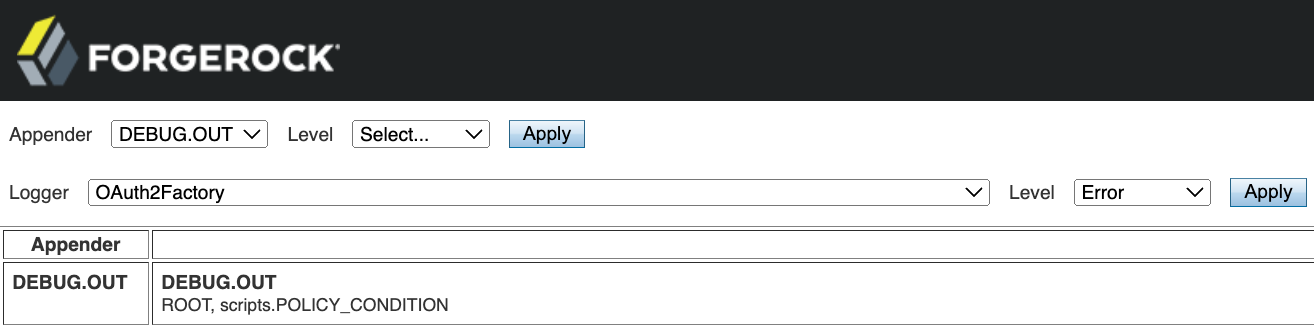
Note that any changes made in the `Logback.jsp` are temporary, and are not persisted to the `logback.xml` file.
### Output to stdout
Configure `logback.xml` to send logging to standard output. For example, for Apache Tomcat deployments, console output is typically redirected to the Tomcat logging file, `catalina.out`.
This example configuration captures all debug-level logging using the default `` element, and redirects it to the STDOUT appender:
```xml
(1)
%d{HH:mm:ss.SSS} [%thread] %-5level %logger{36} - %msg%n
(2)
```
1. To configure this example, create the following elements:
| | |
| ----- | ----------------------------------------------------------------------------------- |
| **1** | An `` that uses the `ch.qos.logback.core.ConsoleAppender` class. |
| **2** | A ``, or a `` element as shown here, referencing the STDOUT appender. |
2. Save your changes as described in [Configure basic debug logging](#config-basic-logging).
3. Check that debug logging is now output to stdout. For example:
`tail -f $TOMCAT_HOME/logs/catalina.out`
### Output to multiple locations
You can direct debug logging to more than one output location by defining multiple appenders and loggers. Note that you can define only one root element.
This example defines loggers for the `com.sun.identity.sm.ServiceInstance` and `org.forgerock.openam.utils.MapHelper` classes that output debug logging to file, using the DEBUG.OUT appender.
All warning-level logging is also directed to standard output using the STDOUT appender.
```xml
(1)
openam/var/debug/debug.out
%lo{5}: %d{ISO8601}: Thread[%t]: TransactionId[%X{transactionId}]%n%level: %m%n%ex
(2)
%d{HH:mm:ss.SSS} [%thread] %-5level %logger{36} - %msg%n
(3)
(3)
(4)
```
1. To configure this example, create the following elements:
| | |
| ----- | ----------------------------------------------------------------------------------- |
| **1** | An `` that uses the `ch.qos.logback.core.FileAppender` class. |
| **2** | An `` that uses the `ch.qos.logback.core.ConsoleAppender` class. |
| **3** | A `` for each script, referencing the DEBUG.OUT appender. |
| **4** | A ``, or a `` element as shown here, referencing the STDOUT appender. |
2. Save and verify your changes as described in [Configure basic debug logging](#config-basic-logging).
### Format log files
The `org.forgerock.openam.logback.JsonLayout` class extends Logback JSON layout functionality by adding the transaction ID to the JSON output.
This example shows how you can include the JsonLayout class to format your log files:
```xml
(1)
openam/var/debug/debugLog.%d{yyyy_MM_dd}.json
7
(2)
(3)
(4)
true
yyyy-MM-dd' 'HH:mm:ss.SSS
true
```
1. To configure this example, create the following elements:
| | |
| ----- | ------------------------------------------------------------------------------------------------------ |
| **1** | An `` that uses the `ch.qos.logback.core.rolling.RollingFileAppender` class. |
| **2** | An `` that uses the `ch.qos.logback.core.encoder.LayoutWrappingEncoder` class. |
| **3** | A `` element that uses the `org.forgerock.openam.logback.JsonLayout` class. |
| **4** | A `` element that uses the `ch.qos.logback.contrib.jackson.JacksonJsonFormatter` class. |
2. Save and verify your changes as described in [Configure basic debug logging](#config-basic-logging).
The use of the JsonLayout class results in the addition of a `transactionId` at the top level of the log entry.
For example:
```json
{
"timestamp" : "2022-07-28 15:39:44.562",
"level" : "DEBUG",
"thread" : "http-nio-8080-exec-6",
"mdc" : {
"transactionId" : "eb0664cc-4615-461e-973a-64a1fc4f659a-34695"
},
"logger" : "org.forgerock.openam.rest.restAuthenticationFilter",
"message" : "OpenAM SSO Token Session Module has successfully authenticated the client",
"context" : "default",
"transactionId" : "eb0664cc-4615-461e-973a-64a1fc4f659a-34695"
}
```
### Rotate debug logs
Logback provides built-in support for a number of log file rotation schemes, including time- and-size based rotation. If you have configured AM with a `logback.xml` file, you can configure log file rotation in the appenders, as follows:
1. In the `` element, create an appender that uses the `ch.qos.logback.core.rolling.RollingFileAppender` class, for example:
```xml
%lo{5}: %d{ISO8601}: Thread[%t]: TransactionId[%X{transactionId}]%n%level: %m%n%ex
```
Within the appender, specify whether to rotate based on time, and optionally also size, as follows:
* To rotate the log files based only on time, add a `` element to the appender, which uses the `ch.qos.logback.core.rolling.TimeBasedRollingPolicy` class.
Include a `` element that defines when the log files should roll over, and the naming convention.
For example, the following appender rolls the log file over at midnight each day, and includes the date in the filename:
```xml
openam/var/debug/dailyLog.%d{yyyy-MM-dd}.log
%lo{5}: %d{ISO8601}: Thread[%t]: TransactionId[%X{transactionId}]%n%level: %m%n%ex
```
* To rotate the log files based on both time and size, add a `` element to the appender, which uses the `ch.qos.logback.core.rolling.SizeAndTimeBasedRollingPolicy` class.
Include a `` element that defines when the log files should roll over, and where the counter for rolling over based on size occurs, specified by including `%i`. You must also include a `` element to define the maximum size of the log files.
For example, the following appender rolls the log file over at midnight each day, but earlier if the file reaches 2 gigabytes in size, and includes the date in the filename:
```xml
openam/var/debug/dailyLog2GB.%d{yyyy-MM-dd}-%i.log
2GB
%lo{5}: %d{ISO8601}: Thread[%t]: TransactionId[%X{transactionId}]%n%level: %m%n%ex
```
2. Save and verify your changes as described in [Configure basic debug logging](#config-basic-logging).
Debug log files will roll over each night, and also if they reach the 2GB size limit. The file names will contain the date, and a counter to signify the order in which they were written.
## Change the startup debug settings
You can configure the settings that are applied when AM starts up and there is no `logback.xml` file present.
The settings specified as defaults will be reflected in the `Logback.jsp` file, for example at `https://openam.example.com:8443/openam/Logback.jsp`. However, they will not override the configuration contained with a custom `logback.xml` file.
### Set the default debug level
These steps set the default debug level used by all loggers, when AM starts up:
1. In the AM admin UI, go to Deployment > Servers > *Server Name* > General > Debugging.
2. Select an option from the Debug Level field.
The default level for debug logging is `Error`. This level is appropriate for normal production operations, in which case no debug log messages are expected.
Setting the debug log level to `Warning` increases the volume of messages. Setting the debug log level to `Message` dumps detailed trace messages.
Unless told to do so by qualified support personnel, do not use `Warning` or `Message` levels as a default in production. Instead, set the levels on a per-class basis.
3. Save your changes.
Changes are applied immediately.
### Set the default debug directory
These steps set the default directory used to store debug log files:
1. In the AM admin UI, go to Deployment > Servers > *Server Name* > General > Debugging.
2. Enter a directory in which to store log files in the Debug Directory field.
The default value is `%BASE_DIR%/%SERVER_URI%/debug`. The `%BASE_DIR%` value equates to the folder containing the AM local configuration, for example `/path/to/openam`. The `%SERVER_URI%` value equates to the deployment URI used when deploying AM, for example `/openam`.
Therefore, the default location for the debug logs resembles the following: `/path/to/openam/var/debug/`.
| | |
| - | -------------------------------------------------------------------------------------------------------------------------- |
| | Make sure that the specified folder can be written to by the account that is running AM or the container in which it runs. |
3. Save your changes.
The changes are applied the next time you restart AM, or the container in which it runs.
### Combine log messages in a single file
These steps log all debug messages to a single `debug.out` file:
1. In the AM admin UI, go to Deployment > Servers > *Server Name* > General > Debugging.
2. Set the Merge Debug Files property to `On`.
3. Save your changes.
Changes are applied immediately.
All debug log messages will be written to a single debug file named `debug.out`. The file will be located in the directory specified in the Debug Directory property. Refer to [Set the default debug directory](#log-debug-directory).