What is Agent Privilege?
Agent Privilege is PingOne Privilege’s identity and security control plane for AI agents, helping organizations authenticate, govern, and authorize workload and personal agents as they access tools, services, data, and other agents. Agent Privilege applies least-privilege, policy-based access while brokering credentials and protecting agent interactions.
In short Agent Privilege:
-
Gives security and platform teams visibility and control over agent activity.
-
Reduces the risk of unauthorized access and AI-specific attacks.
-
Enables organizations to adopt agentic applications with greater confidence.
Who is Agent Privilege for?
Agent Privilege is designed for enterprise organizations where workforce users are running personal AI agents. It applies across two primary user groups:
-
All workforce users: Employees using AI agents to interact with MCP-protected resources, such as internal APIs or services exposed through MCP servers.
-
Developers and privileged users: Engineers and administrators using AI coding agents that access Git repositories and need attributable, policy-controlled commits.
Agent Privilege architecture
Agent Privilege secures agent traffic at a set of brokered enforcement points rather than inside each agent.
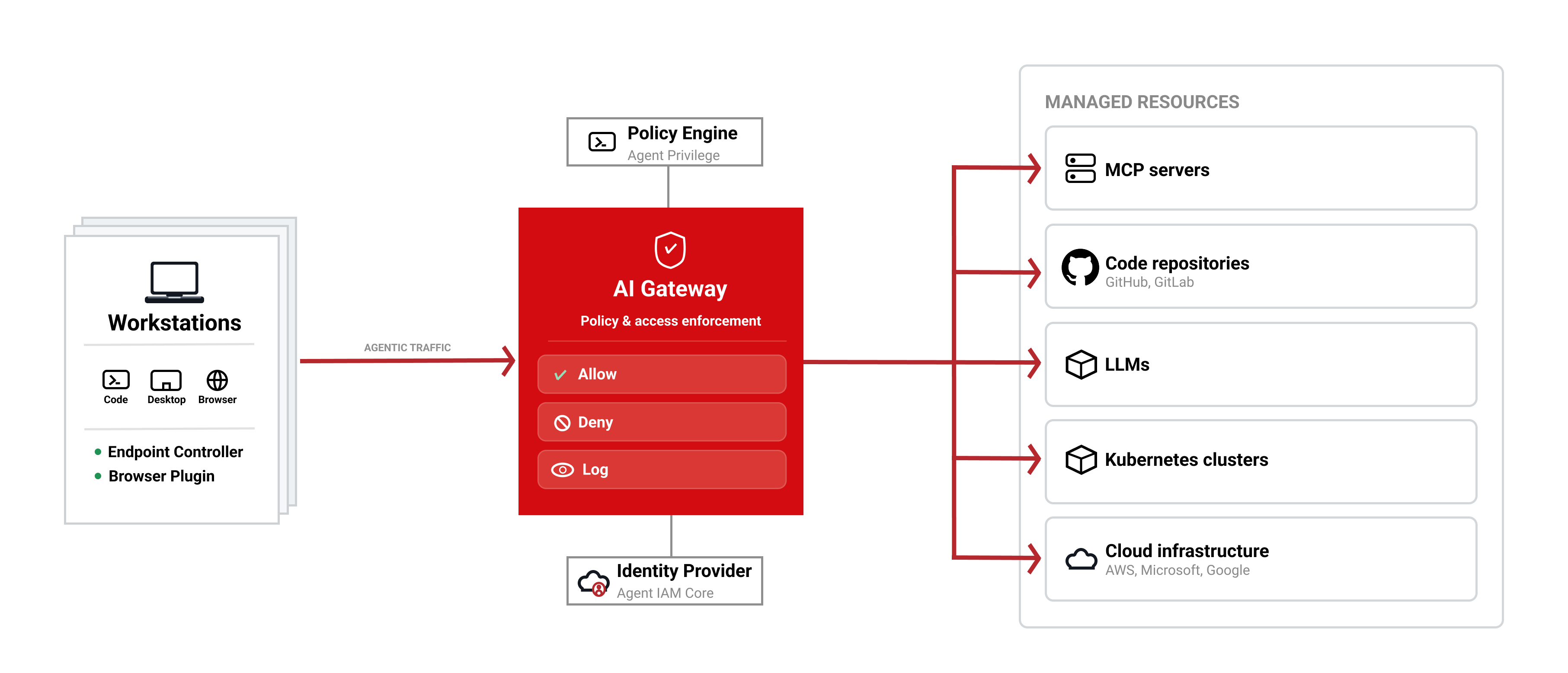
The general pattern:
-
Agents authenticate with short-lived, scoped identity. Personal agents connect with a delegated user identity. Workload agents and NHIs present federated tokens, such as Kubernetes service-account tokens, continuous integration (CI) job tokens, SPIFFE JWT-SVIDs, or tokens from any OpenID Connect (OIDC) issuer with published keys.
-
Tokens terminate at the gateway. Agent credentials and tokens are validated and terminate at the gateway and are never forwarded downstream. Backend services receive only the credential PingOne Privilege injects at request time, such as the caller’s User Vault credential or the application’s configured credential.
-
Policy is applied inline. Each request is evaluated against the tool, model, and connection policy configured for the agent, and AI Guard inspects content in both directions across MCP, A2A, and LLM traffic.
-
Every interaction is recorded. Tool calls, policy decisions, and approvals are captured as audit records and can be streamed to a SIEM.
Agent Privilege capabilities
- AI Discovery
-
Identifies AI activity across managed endpoints, including installed AI tools, local models, browser-based AI services, and MCP servers.
- MCP Gateway
-
Connects AI agents to MCP servers through a managed gateway that authenticates every request with a real user identity, authorizes at the level of individual tools, prompts, and resources, and injects the backend credential the server expects, so the agent never holds it. Tools a user isn’t entitled to are removed from listings in flight, and every tool call is recorded for audit.
- Secretless Access
-
Agents authenticate with short-lived, audience-scoped tokens their platform already issues (Kubernetes service accounts, CI/CD job tokens, SPIFFE identities, or OIDC) which PingOne Privilege verifies against the issuer’s published keys. Secrets are never exposed to the user or agent, authenticating with short-lived, audience-scoped tokens.
- Agent Commit
-
Controls AI agent access to Git repositories using SSH certificate authority (SSH CA) authentication, ensuring that commits made by coding agents are attributable to the human user on whose behalf the agent acted.
- User-Level Attribution
-
Ties every action to the identity that performed it. The gateway injects each user’s own credential into their requests, so target systems see who actually acted instead of a shared service account, and every tool call, model request, and Git operation lands in the audit trail under a specific identity.
- Secrets Bridge
-
Puts request-and-approve policy in front of the secrets already in your enterprise vaults (AWS Secrets Manager, GCP Secret Manager, Azure Key Vault, Delinea, and CyberArk PAM) without duplicating them. Instead, values are fetched live from the provider at the moment of an authorized read and are never stored by PingOne Privilege.
- LLM Control
-
Replaces provider API keys with virtual keys issued per user and revocable instantly. Policy restricts each key to approved models and enforces daily, weekly, monthly, or lifetime spend and rate limits, while every request records model, tokens, cost, latency, and status.
- AI Guard
-
Inspects agent content in and out across MCP, agent-to-agent, and LLM traffic for prompt injection, jailbreaks, data exfiltration, unsafe tool use, hidden instructions, PII, and inter-agent abuse, responding per policy with allow, alert, sanitize, or block.
- Session Manager
-
Manage or terminate an agent’s access immediately with full session management and killswitch capabilities.