Certificate Collector node
The Certificate Collector node collects a chain of X.509 digital certificates from the incoming request. The journey can then use the collected certificates as authentication credentials for a user or an OAuth 2.0 client.
Advanced Identity Cloud accepts certificates in PEM and DER format.
|
Version 1.0 of this node collects only the first certificate in a certificate chain (the user certificate) and ignores the remaining certificates in the chain. To collect all certificates in the chain, upgrade to v2.0 of the node. You can’t use this node in isolation because it only collects certificates from the request. It doesn’t extract or validate the certificate’s content. Use a Certificate Validation node to validate certificates and a Certificate User Extractor node to extract the user details from the certificate. |
Example
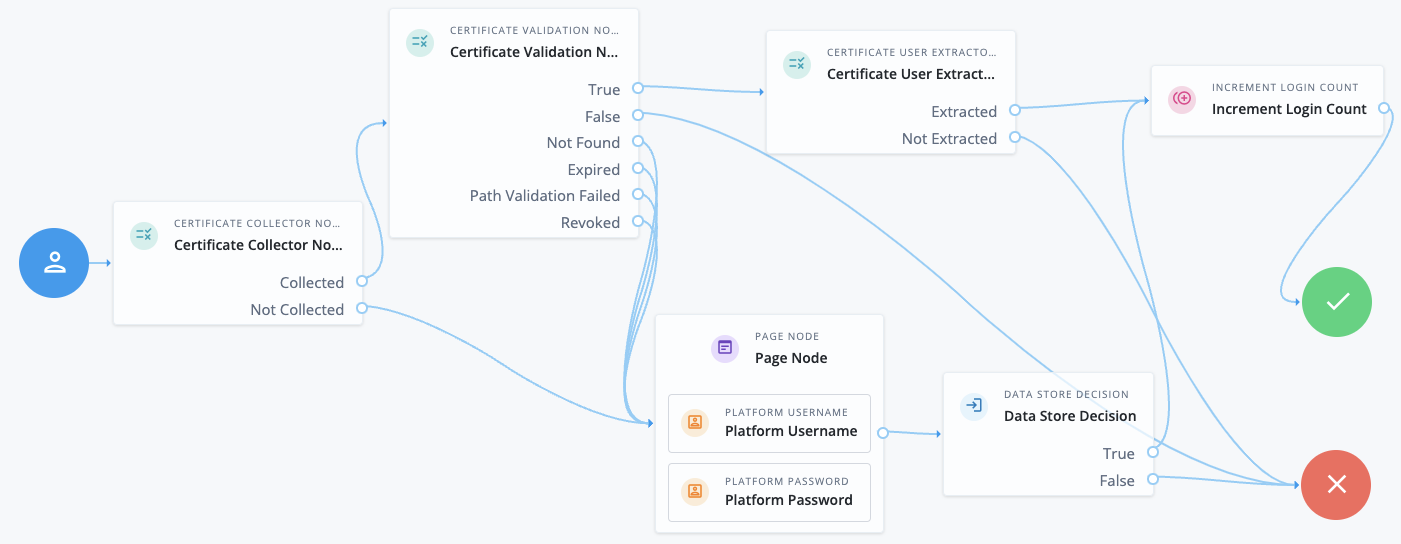
This example shows an authentication journey using a certificate as credentials.
-
The Certificate Collector node attempts to collect the certificate chain from the request body or the header.
-
If the node can collect the certificates, the journey proceeds to the Certificate Validation node.
-
If the node can’t collect the certificates, the journey proceeds to a Page node containing a Platform Username node and a Platform Password node to let the user authenticate with username/password credentials.
-
-
The Certificate Validation node attempts to validate the certificates based on the configuration of that node.
-
If the certificates can be validated, the journey proceeds to the Certificate User Extractor node.
-
If the certificates are invalid, the journey proceeds to the Failure node.
-
In all other cases, the journey proceeds to a Page node containing a Platform Username node and a Platform Password node to let the user authenticate with username/password credentials.
-
-
The Certificate User Extractor node extracts the user ID from the certificates and attempts to find a match in the identity store.
-
If the username can be extracted and a matching user is found in the identity store, the journey increments the login count and authenticates the user.
-
If the username can’t be extracted or no matching user is found in the identity store, the journey proceeds to the Failure node.
-
Availability
| Product | Available? |
|---|---|
PingOne Advanced Identity Cloud |
Yes |
PingAM (self-managed) |
Yes |
Ping Advanced Identity Software (self-managed) |
Yes |
Inputs
This node reads the certificates from the request payload or request header. It doesn’t read anything from the shared state.
Configuration
| Property | Usage | Availability |
|---|---|---|
Certificate Collection Method |
How the node should collect the certificates from the request. Possible values are:
Default: |
All node versions |
HTTP Header Name for the Client Certificate |
The name of the HTTP header that contains the certificates.
If you set the Certificate Collection Method to Default: No value |
All node versions |
Trusted Remote Hosts |
A list of IP addresses trusted to supply certificates on behalf of the authenticating client, such as load balancers doing TLS termination. If you don’t set a value here, Advanced Identity Cloud rejects certificates supplied by remote hosts.
If you set a value of Default: No value |
All node versions |
Outputs
The node outputs the X.509 certificate or chain of certificates to the transient state to be consumed by the Certificate Validation node.
Outcomes
Collected-
The node was able to collect the certificates.
Not Collected-
The node was unable to collect the certificates.
Errors
The node can log the following errors:
-
Certificate was not successfully collected based on node configuration and client requestNo certificates are provided in the configured location (either header or request).
-
CertificateFromParameter decode failed, possibly invalid Base64 inputThere’s a problem with the certificates provided in the header or in the request.