LexisNexis Dynamic Decision Platform (DDP)
LexisNexis Dynamic Decision Platform (DDP) unifies the key components of fraud prevention into a single, holistic risk decision platform. DDP connects multiple data sources and intelligence signals, enabling real-time orchestration of risk decisions. When the nodes are integrated, the risk assessment policy hosted within the DDP returns a risk score mapped to outcomes such as step-up authentication, passing without further friction, or rejecting the transaction.
Advanced Identity Cloud lets you implement risk assessment using these authentication nodes:
| These nodes were formerly named ThreatMetrix. |
Example
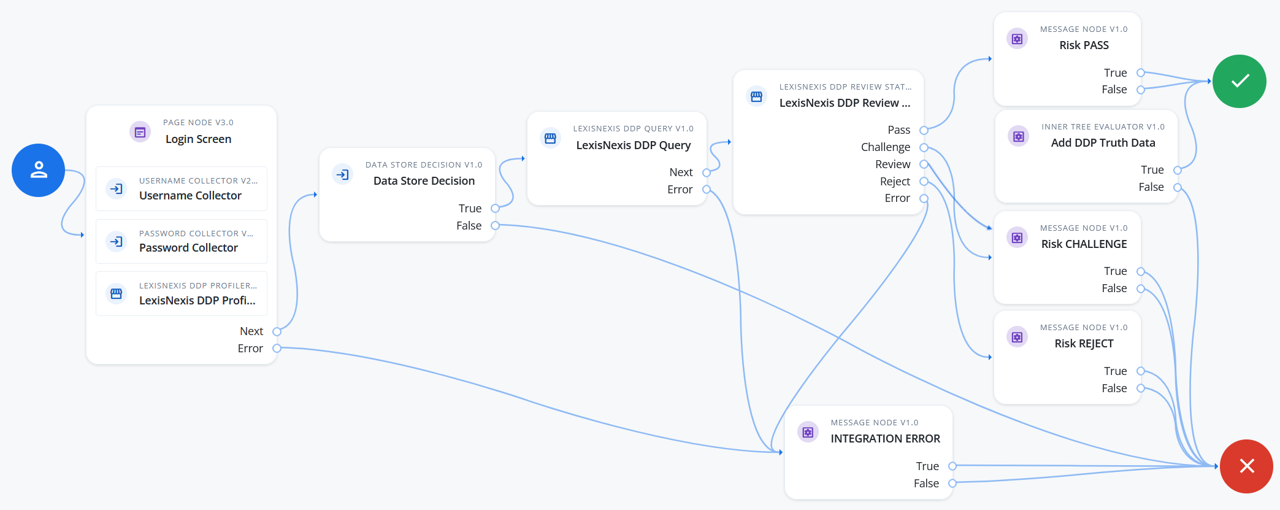
The following example shows a typical authentication journey using the LexisNexis DDP nodes for risk assessment:
-
The journey starts with a Page node to capture username and password.
-
Simultaneously, the LexisNexis DDP Profiler node captures device intelligence information associated with a unique session ID.
-
The Data Store Decision node confirms the username-password credentials.
-
The LexisNexis DDP Query node uses the session ID, along with user personally identifiable information (PII), to make an API call to the DDP for risk assessment:
-
Risk assessment is performed at the DDP to capture suspicious activity.
-
The result of the risk assessment is captured as an API response in the journey.
-
-
The LexisNexis DDP Review Status node interprets the API risk assessment response:
-
The possible outcomes to continue the journey are
Pass,Challenge,Review, orReject. -
The
ChallengeandReviewoutcomes start a step-up second factor authentication. -
The node adds truth data to the login event, which enriches the information in the network and enhances fraud detection.
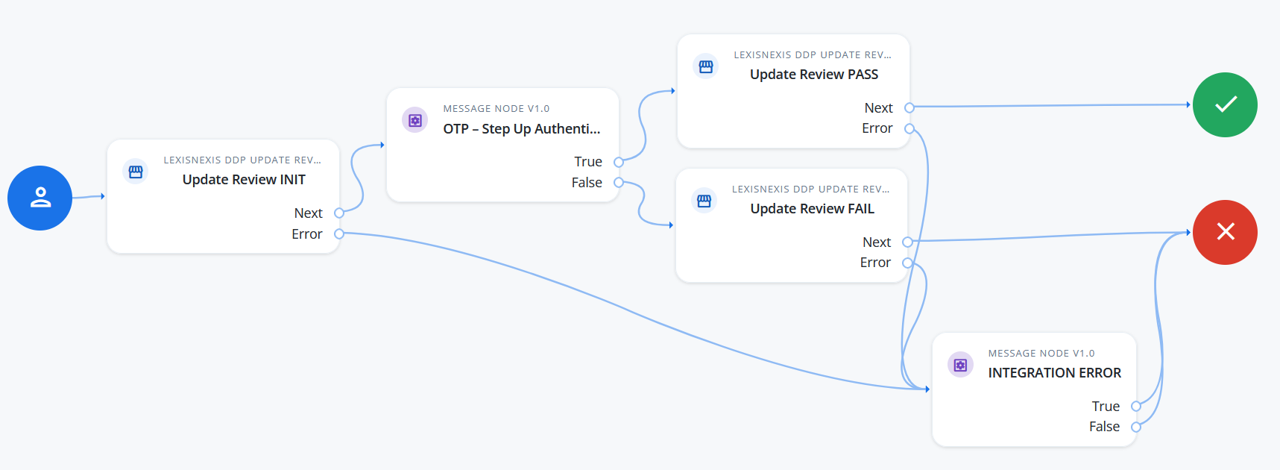
The example shows initialization of step-up MFA along with an outcome of either pass or fail.
A step-up authentication that’s initialized but not completed is a sign of potential fraud in the login event.
-
The following example shows a one-time passcode (OTP) step-up journey with retrospective truth data through the LexisNexis DDP Update Review node. The journey is called from an inner tree evaluator node in another journey that performs the DDP risk assessment:
-
The LexisNexis DDP Update Review node uses the
ddp.request_idvalue stored in shared state to link retrospective truth data to the risk event API response from the LexisNexis DDP Query node. -
Truth data improves the fidelity of risk assessments over time.