Atlassian Jira
The Advanced Identity Cloud Atlassian Jira application lets you manage and synchronize data between Advanced Identity Cloud and Atlassian Jira.
Register the application
-
In the Advanced Identity Cloud admin console, go to Applications > Applications, and click Browse App Catalog.
-
In the Browse App Catalog modal, select an application, and click Next.
-
Review the Application Integration information, and click Next.
-
In the Application Details window, specify the name, description, application owners, and logo for the application.
-
To make the application an Authoritative source of identity data, select the Authoritative check box. This option is not available for every application.
-
Click Create Application.
Configure the provisioner
After you register the application, you can configure provisioning.
-
In the Advanced Identity Cloud admin console, on the Provisioning tab:
-
If setting up provisioning for the first time, click Set up Provisioning.
-
When editing existing settings in the Connection area, click Settings.
-
-
Configure the following fields:
Field Description SCIM Endpoint
The URL defining the root for the SCIM endpoint. For example,
https://myserver.com/service/scim.SCIM Protocol Version
Choose version 1 or version 2. The default is 1.
Authentication Method
The method for authenticating on the remote server:
BASIC,OAUTH, orTOKEN. The default isTOKEN. -
Depending on the Authentication Method, configure the applicable fields:
-
BASIC
-
OAUTH
-
TOKEN
Field Description User
The basic authentication username for the SCIM service.
Password
The basic authentication password for the SCIM service.
Field Description Token Endpoint
The OAuth 2.0 endpoint where a new access token is requested for the SCIM service.
Client Id
The OAuth 2.0 client identifier for the SCIM service.
Client Secret
The OAuth 2.0 client secret for the SCIM service.
Scope
The OAuth 2.0 scope to use.
Grant Type
The OAuth 2.0 grant type to use (
client_credentialsorrefresh_token).Refresh Token
Used by the
refresh_tokenGrant Type.Field Description Auth Token
The auth token for the SCIM service.
-
-
Configure the HTTP connection pool:
Field Description Maximum Connections
The maximum size of the http connection pool. The default is 10 connections.
-
Optionally, click Show advanced settings to set any of the following options:
Application specific settings Field Description Disable Http Compression
Content compression is enabled by default. Select this property to true to disable it.
Connection Timeout
Define a timeout (in seconds) for the underlying http connection. The default is 30 seconds.
Debug/Test settings
Only use these settings for test environments. Don’t enable for production environments. Selecting this option displays the following options:
-
Accept Self Signed Certificates: Enable to accept self-signed certificates.
-
Disable Host Name Verifier: Enable to disable hostname verifiers.
Read Schema
Read/discover the schema from the Atlassian SCIM endpoint. If
true(enabled), the application reads the schema from the server. Iffalse(disabled), the application provides a default schema based on the object classes in the configuration. The default value istrue(enabled).Exclude Unmodified
Select this option to synchronize only the modified properties on a target resource.
Pool configuration Field Description Max idle and active container instances
The maximum number of idle and active container instances. The default value is
10.Max Idle Connector Instances
The maximum number of idle connector instances. The default value is
10.Set Timeout Period
Select to enable a timeout period for the connection. After enabling, configure the following:
-
Timeout period (ms): The timeout period in milliseconds.
Set Minimum Idle Time
Select to set a minimum time (in milliseconds) before an idle object is removed. After enabling, configure the following:
-
Min idle time (ms): The minimum idle time in milliseconds.
Min Idle Instances
The minimum number of idle connector instances.
Result Handler configuration Field Description Enable for connectors with the attribute normalizer interface
Enables the attribute normalizer interface for supported connectors.
Enable local filtering/search features
Enables local filtering and search capabilities.
Enable case insensitive filter
Configures filters to ignore case sensitivity.
Enable configuration of search attributes; disable for local connectors
Enables search attribute configuration. Disable this option for local connectors.
-
In the Operation Timeouts (ms) area, select the operations to enforce timeouts on and enter the duration in milliseconds.
Available operations include Create, Validate, Test, Enable a Script on the Connector, Schema, Delete, Update, Sync, Authenticate, Get, Enable a Script on the Target, and Search.
-
In the Operation Rate Limits area, select the operations to enforce rate limits on.
You can enforce limits on specific operations, including Create, Validate, Test, Script on Connector, Schema, Delete, Update, Sync, Authenticate, Get, Script on Target, and Search.
For each selected operation, configure the following fields:
Field Description Request Limit
Requests allowed over time.
Request Period
Limit resets after this time (ms).
Request Timeout
Time before exception thrown (ms).
-
-
Click Connect.
-
Verify the information in the Details tab.
Configure provisioning and reconciliation resources
Use the object type list to select a provisioning and reconciliation resource, such as Account.
The selected object type determines the side tabs that display, as each resource has different provisioning and reconciliation requirements.
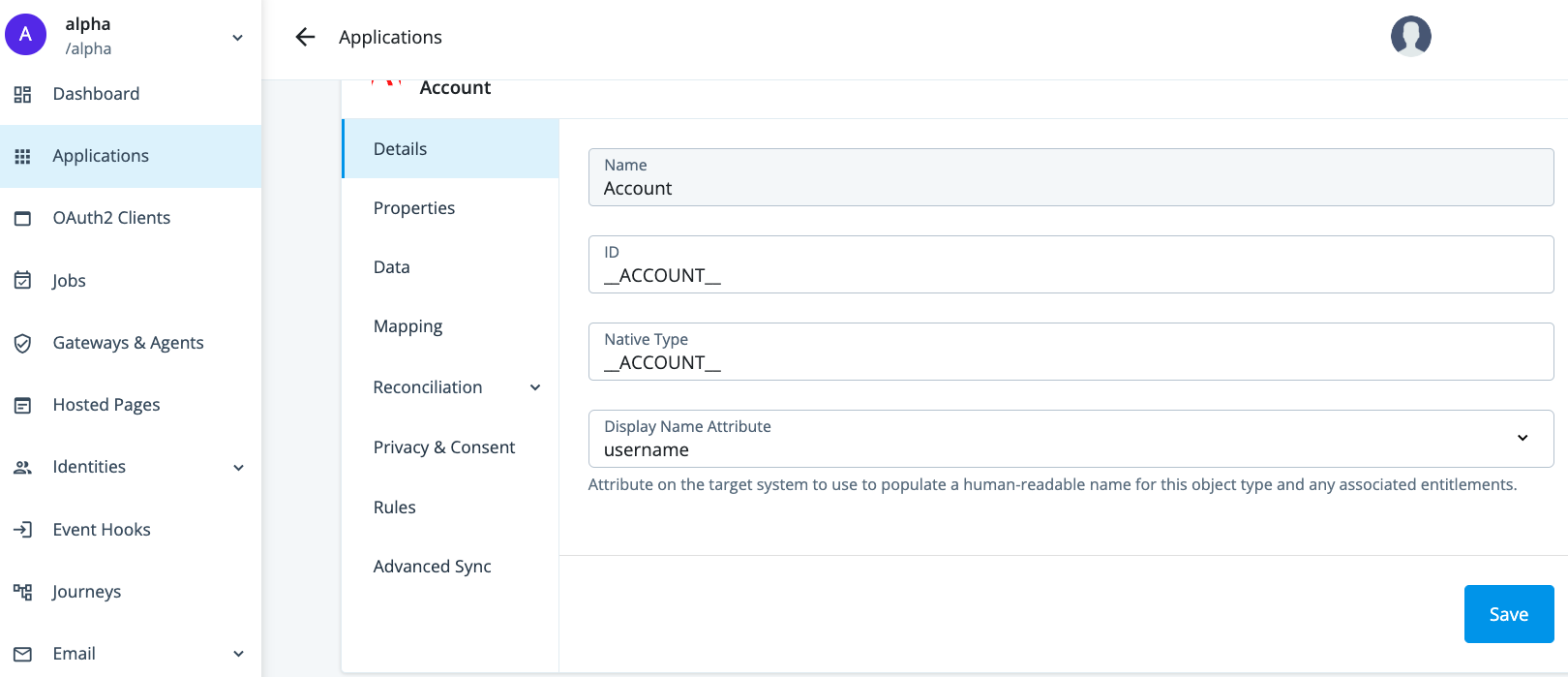
| Provisioning side tab | Description | Related sections |
|---|---|---|
Details |
View and manage an application, including name, ID, and native type. |
Select the specific application from Provision settings for an application. |
Properties |
View and manage properties for the selected object type. |
|
Data |
View data about the selected object type. |
|
Mapping |
View and manage mappings from the Advanced Identity Cloud admin console properties to external system properties and from external system properties to the Advanced Identity Cloud admin console properties. |
|
Reconciliation |
Preview mappings on target applications between external systems and the Advanced Identity Cloud admin console, and reconcile the data between the two systems. View and manage rules for the users and groups that use your application. View and manage schedules for Full and Incremental reconciliation. |
|
Privacy & Consent |
Manage end-user data sharing and synchronization. |
|
Rules |
View and manage provisioning rules for mappings between Advanced Identity Cloud and a target application. |
|
Advanced Sync |
Create and manage mappings between a managed object type and an application or between applications. |