Viewing dependents
Before you change a policy or an element in the PingOne Authorize Trust Framework, view dependents to see where the policy or element is used. This helps ensure that updates don’t introduce unintended consequences.
Steps
-
Select the authorization element you want to view dependents for.
Choose from:
-
Select a Trust Framework definition:
-
In the PingOne admin console, go to Authorization > Trust Framework.
-
In the Module list, select the module that contains the definition, and then select that definition.
-
-
Select an authorization policy:
-
In the PingOne admin console, go to Authorization > Policies.
-
In the Module list, select the module that contains the policy, and then select that policy.
-
-
-
In the Name field, click the hamburger menu and select View Dependents.

Result:
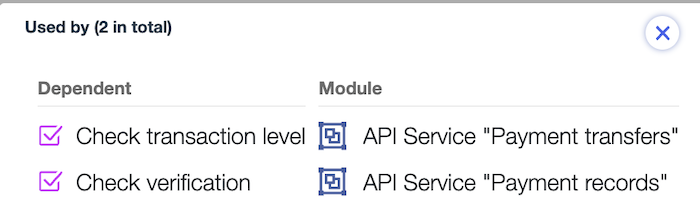
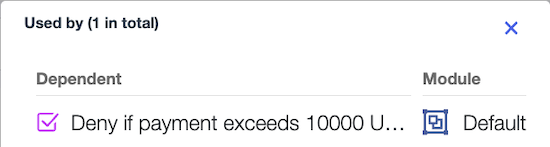
Dependents are shown in a new modal:
Example: Viewing dependents across modules
Suppose an environment has two API services with custom policies enabled, Payment records and Payment transfer. Both services' custom policies reference a Verification level attribute that’s defined in the Default module’s Trust Framework:
-
For the Get payment records operation on the Payment records API service, a custom policy permits a customer to view payment records when their verification level is High.
-
For the Create payment transfer operation on the Payment transfer API service, a custom policy requires a verification level of High for transfers over 10,000 USD.
Viewing the dependents of the Verification level attribute shows both policies, even though each policy belongs to a different module: